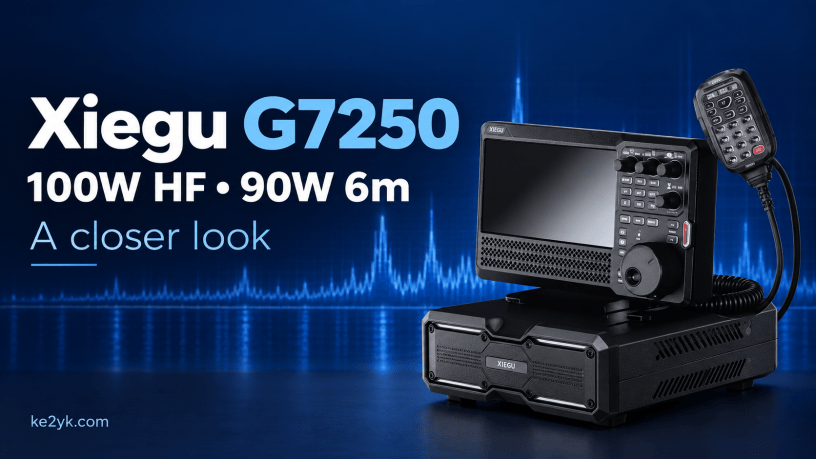
A big screen, a separate control head and more power make this new Xiegu worth a look.
Looking for a new radio for your shack? The Xiegu G7250 promises 100 watts on HF and 90 watts on 6 meters. It also has a 7-inch touchscreen and a built-in antenna tuner.
This is a preview based on the ad and seller pages checked September 21, 2026. We have not tested the radio on the air.
More room on your desk
The G7250 comes in two main parts: a control head with the screen and knobs, and a box that holds the radio hardware. You can put the controls within easy reach and place the other box elsewhere.
That could help in a small shack. Check the cable length and leave room around the radio for cooling.
Power for HF and 6 meters
Radioddity lists up to 100 watts on HF and 90 watts on 6 meters. If you use a 20-watt radio now, that means more power without adding a separate amplifier.
More power may help other hams hear you. A good antenna still matters, though. The extra power won’t fix a poor antenna or noise at your station.
The promised features at a glance
The Xiegu.eu announcement and Radioddity product page list these features. The benefits below explain why they may help in the shack. They are not results from our own tests.
| Promised feature | What it could do for you |
|---|---|
| Separate 7-inch control head | Keep the screen and knobs close while placing the main radio box elsewhere. |
| Spectrum and waterfall display | Show where signals are active, with a scrolling view of recent activity. |
| Direct RF sampling SDR | Turn incoming radio signals into digital data for processing inside the radio. |
| Adjustable filters and noise controls | Help cut unwanted sound while you listen for the station you want. |
| Built-in antenna tuner with memory | Recall an earlier match when you return to a band with the same antenna setup. |
| USB audio for computer modes | Radioddity advertises a one-cable computer link for FT8, without a separate audio interface box. |
| Two selectable antenna sockets | Keep two antennas connected and choose one. This does not let you hear two bands at once. |
| Stored CW messages and voice playback | Repeat common calls without sending or speaking the whole message each time. |
See the band while you listen
A radio with a basic frequency display tells you where you are tuned. A spectrum display adds a wider view. Peaks show signals nearby, while the waterfall leaves a short trail of activity over time.
That can help when you are hunting for a contact or checking whether a band is busy. You still need to listen before transmitting. An empty spot on a screen does not prove that a frequency is clear.
The G7250 also keeps a tuning knob and buttons. That gives you a choice: use the screen for a quick look, then turn the knob as you would on a familiar rig.
What makes this layout different?
In a one-box desk radio, the display, controls and radio hardware share one case. Wherever that case fits is where you must reach to tune it. The G7250 separates those jobs into two boxes.
Picture a small desk with a logbook, key and computer. You could keep the control head beside your keyboard and place the main radio on a nearby shelf, within the allowed cable length. The tradeoff is another cable to route and two pieces to mount or pack.
This design is not unique, and many modern transceivers already offer waterfalls, USB audio and digital filters. The G7250’s appeal is how it brings those tools together with a large, separate control head and 100-watt HF output. It is the full package that deserves a look.
What does SDR mean for everyday use?
SDR means software-defined radio. Older receiver designs do more of their signal handling through fixed radio circuits. A direct-sampling SDR turns the signal into digital data early, then uses digital processing to do much of that work.
For the operator, the useful part is control. A narrow filter can help you focus on a CW signal. A wider setting may suit a voice contact. Noise controls may make a rough signal easier to hear, though strong settings can also change how voices sound.
SDR alone does not mean a better receiver. We still need to hear how this rig handles weak stations beside strong ones, and how easy its controls are to use during a busy evening on the bands.
The tuner helps, but has limits
Xiegu.eu lists a tuner matching range of 20 to 150 ohms. Think of that as the range of antenna loads it is designed to handle. It is not a promise to tune any length of wire on every band.
A built-in tuner can save space and make band changes easier. It cannot fix feed-line loss or turn a poor antenna into a good one. Keep the antenna plan near the top of your station checklist.
Watch the video
Check before you preorder
Prices and delivery dates differ by seller. At our check, Xiegu.eu listed EUR 1,090 and a September 30, 2026 release date. Radioddity listed US$999, with estimated arrivals from November into early December, depending on shipping.
These dates are estimates. Before paying, check shipping costs, return rules, warranty support and the latest delivery news.
Worth watching?
The G7250 could suit hams who want more power, a large screen and a flexible desk setup. We’ll need tests of radios that reach buyers before judging how well it works.
Would a separate screen and control head fit your shack? Let us know in the comments.
Source links:
Follow Me on Mastodon
Discover more from KE2YK
Subscribe to get the latest posts sent to your email.

