Originally published October 19, 2007 | Updated November 3, 2026
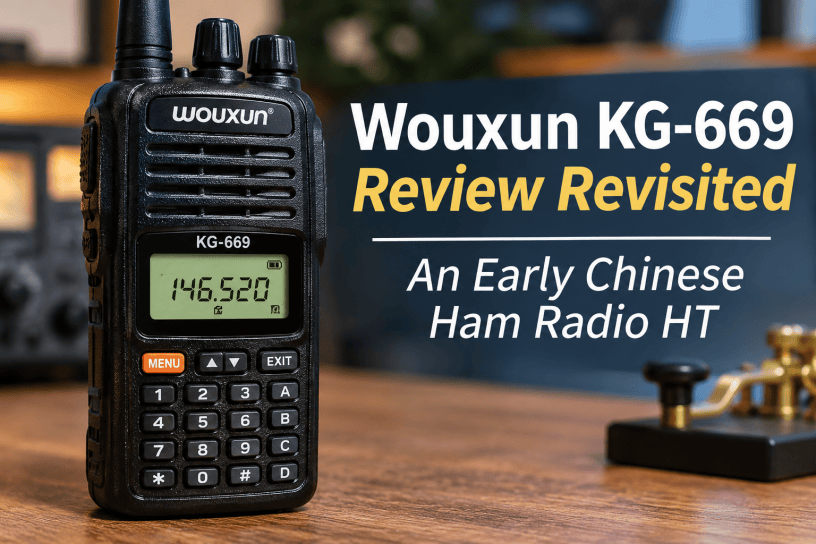
Long before inexpensive Chinese handheld radios became common in amateur radio, Wouxun was already making waves with affordable VHF and UHF equipment.
One of those early radios was the Wouxun KG-669, a single-band handheld transceiver that offered plenty of features at a low price.
Back in 2007, a friend purchased one, and we spent several hours trying to figure out how to program and operate it.
Here’s what we discovered.
First Impressions: Better Than Expected
The KG-669 arrived with a desktop charger, belt clip, hand strap, and a poorly translated instruction manual.
The radio itself was a pleasant surprise.
It felt solid, with better construction than we expected from such an inexpensive handheld. The controls and overall appearance were reasonably good.
Unfortunately, operating the radio was another story.
A Manual That Made Things Difficult
The instruction manual was one of the biggest problems.
Poor English translations made even simple operations confusing. My friend and I had plenty of experience with amateur-radio equipment, but the KG-669 tested our patience.
Programming repeater frequencies and memory channels was especially frustrating.
Eventually, we discovered that the repeater frequencies, offset, and CTCSS settings had to be entered and stored in a particular sequence.
Once we figured that out, the radio became much easier to use.
Another odd feature was switching between frequency mode and memory mode. This required turning the radio off and restarting it while holding down the menu button.
Not exactly convenient!
Features: Plenty for the Money
For its time, the KG-669 offered an impressive collection of features.
- Single-band VHF or UHF operation, depending on the model
- Up to 5 watts advertised output on VHF
- 128 memory channels
- CTCSS and DCS signaling
- VOX operation
- DTMF functions
- Voice announcements
- Selectable channel spacing
- Computer programming capability
- Rechargeable lithium-ion battery
One important point: the KG-669 was not a dual-band radio.
Some advertising and specifications could give buyers the wrong impression because they described both VHF and UHF versions.
You needed to purchase the correct model for the band you intended to use.
Those Annoying Voice Prompts
The KG-669 included spoken announcements for various functions.
The voice could be changed between Chinese and English, but the announcements quickly became annoying.
It was a feature I would have preferred to disable.
Sometimes a simple beep is all a radio needs.
What About FCC Rules?
One concern I raised in the original review involved the radio’s wide transmit-frequency coverage.
Some versions could transmit outside the amateur bands, including frequencies assigned to other radio services.
That remains an important distinction today.
In the United States, amateur-radio transmitters generally do not require FCC equipment certification simply to operate in the amateur service. However, operators remain responsible for transmitting only on authorized frequencies and complying with applicable technical rules.
A radio’s ability to transmit on a frequency does not mean an amateur operator is authorized to use it.
Was the KG-669 Really That Bad?
Looking back, I may have been harder on the KG-669 than its actual performance deserved.
The radio had genuine shortcomings, especially its manual and programming procedure.
But the construction was better than expected, and I later acknowledged that the KG-669 could outperform some more expensive handhelds under certain everyday conditions.
Readers of the original review also shared different experiences. Some strongly defended Wouxun radios and praised their value.
Those comments remain part of the original discussion below.
Final Thoughts: A Look Back at an Early Budget HT
The Wouxun KG-669 was far from perfect.
Its confusing manual, awkward programming, and unnecessary voice announcements made it frustrating to use.
Yet it also demonstrated something important: inexpensive handheld radios could offer useful features and respectable performance without a premium price tag.
Today, the KG-669 is best viewed as an interesting piece of amateur-radio history rather than a current buying recommendation.
Nearly two decades later, affordable handhelds are everywhere. The KG-669 was one of the radios that helped introduce operators to that changing market.
73, KE2YK
This review reflects hands-on experience with the Wouxun KG-669 in 2007. It has been edited for clarity and updated to provide historical context. It is not a new hands-on test.
More at KE2YK.com
Follow Me on Mastodon
Discover more from KE2YK
Subscribe to get the latest posts sent to your email.


try the KG-689, it realy is a big improvement, the manual is still very badly translated but the radio is much better, it is still only a single band, but has dual VFO, as for voice promts and the fm radio function i find both useful when using the radio on my motorcycle. overall i think wouxun will go far, anything cheaper realy is just a toy, try a jingtong for a laugh, then use it as a door stop, or some other non radio purpose
LikeLike
Thanks for the comment Jake. I agree with your take on the knock offs!
LikeLike
I have 2 KG 689`s and have to say the above review is utter tosh.
Having used handies by the major manufacturers, the Wouxun is clearer , simple to use once you get the hang of it, and a high quality item for frankly very little money.
The reviewer displays snobbery when it comes to these cheap chinese radios….ahem…who do you think makes your top dollar equipment?
The ability to listen to two frequencies at once is a boon if you use these radios in connection with sporting events or other circumstances when you need to listen into more than one source.
Put your snobbery to one side.
BTW, they now have CE approved versions of their radios, so, expect big things in future.
Get one now while they are still available for buttons on ebay.
LikeLike
Sir,
I would not refer to it s snobbery, rather constructive criticism or buyer beware! However, to add a bit more to your welcomed response, I did actually purchase a KG669. I did find that It outperformed other ‘brand name” HT’s under certain, every-day circumstances. Again, thank you for your post.
Regards,
Gary (ke2yk)
LikeLike
Fair comment ke2yk , but I think there is a more honest review here –
http://reviews.ebay.com/Wouxun-KG-689-amp-KG-679-Plus-VHF-version-with-Scrambler_W0QQugidZ10000000004627601?ssPageName=BUYGD:CAT:-1:SEARCH:4
Whilst I accept and understand your concerns re illegal use of these radios, most purchasers are I suspect amateur radio enthusiasts, or business users .
Given that a I paid aprox 70 dollars delivered for a radio that outperforms 400 dollar equipment, I have to give an honest appraisal and say, it is worth a risk at the prices quoted.
I am aware that the quality of some of the chinese stuff is porr, but, this company seem to be at the top end of the market quality wise , evidenced by their designs on world sales by type approval.
I suspect as word gets out, prices will inevitably rise.
LikeLike
Felt compelled to add my 2 cents concerning the KG-689. I purchased 2 VHF and 2 UHF versions of this unit for use on 2m and 70cm (nice to have 420-430 access) plus MURS (CB for aviation HTs) and GMRS (licensed). Performance on both bands is quite good. Plus the quality of workmanship for the price is excellent. A cloning cable allows you to configure one unit then copy memory to another. And IMO the user’s guide for the 689 is perfectly understandable. BTW, at ebay this item is overpriced. I bought one unit from there (@ $95 total for UHF) then located a better source online at asiaradiosales dot com ($80 for UHF, $77 VHF, including shipping, via PayPal). And I must admit that the motivation for multiple purchases was the suspicion that the price of these things can go nowhere but up. Also saw at the Wouxun dot com site that they have a new (certified) 699E version of the same unit. Other than the inclusion of a 1750Hz tone if you need it, the specs seem similar enough.
Anyway, if used responsibly, I don’t see why these units would be suspect. After all, if you were to build from scratch an xcvr using schematics from an old ARRL Handbook which met current stability specs, would it be suspect to use it?
LikeLike
I also bought my rig at asiaradiosales dot com. I got my rig after 12 days which is not bad. I have seen that they have a new version of the KG689E with 1750Hz and 66-88mhz.
LikeLike
I got my wouxun 689E version and it is one of the best radios i have ever had. I got this radio from asiaradiosales dot com. Thanks for the speedy delivery great rig i would recommend for everyone
LikeLike
Preciso do manual do HT WOUXUN, UHF ou onde encontrar..
LikeLike
Thank You Tremendously, I have just returned to Radio after 12 years QRT. This article helped me no end as I was considering buying one, Thanks, again, Pete
LikeLike
Ola desculpe o incomodo, seria possivel me mandarem o manual do kg 669 5 w . s/n slreh03-5005
Freq-136,000-174,000 mhz
LikeLike
KG-699E. The mic gain and deviation are too low. Does anybody know if there is a hidden menu to correct this problem? Surprisingly Wouxun have been no help. Otherwise the radio is very good. Programming is much easier with the software provided although it only runs on XP, not Vista.
LikeLike
i have recently bought ‘KG-689 Dual Channel Standby 5W 10KM Walkie Talkie with ANI and VOX’ , in the manual it clearly says thats its for UHF/VHF , it describes both frequencies , but it only works for UHF , can you tell me how i can turn it to VHF ?
LikeLike
you need another antenna for VHF
LikeLike
You will have the UHF version… they are not dual band.
LikeLike
I looked at the manual for one of these and it makes reference to the FCC. Makes one wonder about the legality of importing these. Is there a possibility that these are business band radios in china and are allowed to be used in the US much like the Motorola Business equipment being repurposed for ham use?
LikeLike
i own a kg669. does anyone know how to get better audio on one of these radios as mine is very low.. can they be turned up by the menu?
LikeLike
What a terrible review. I suggest you pick up the Wouxun again and learn to use it properly, then re-write your review!
The Wouxon radios are very good all round and are beginning to give the likes of Icom and Kenwood and run for their money!
LikeLike