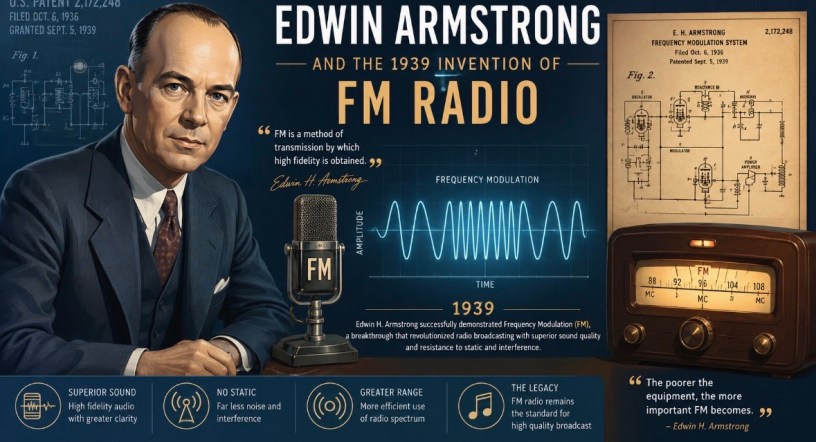
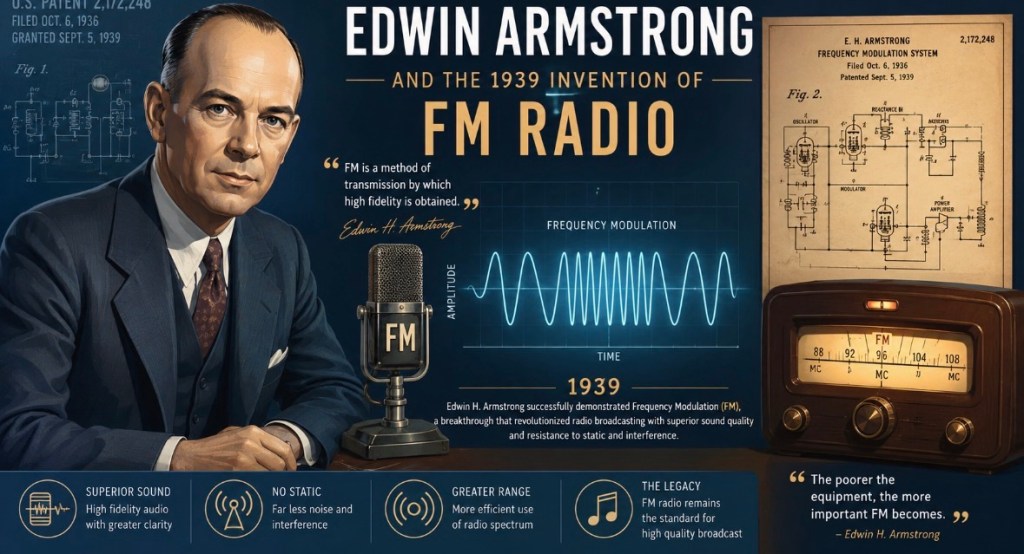
Edwin Howard Armstrong was one of the most influential inventors in the history of radio. Born in 1890, Armstrong became fascinated with wireless technology and went on to develop several groundbreaking inventions. His work on the regenerative receiver, superheterodyne receiver, and eventually frequency modulation (FM) helped shape the future of radio communications. While many of his inventions were important, his development of wideband FM would become his most famous contribution.
During the early days of broadcasting, AM radio was the dominant technology. AM worked by varying the amplitude of a radio carrier to represent the audio signal, but this also made it vulnerable to electrical interference and atmospheric noise. Static from thunderstorms, electrical equipment, and other sources could make listening frustrating. Armstrong believed radio engineers shouldn’t simply accept static as an unavoidable problem—there had to be a better way to transmit a clean audio signal.
Armstrong’s solution was frequency modulation, or FM. Instead of varying the amplitude of the carrier, FM varies its frequency in response to the audio signal. Armstrong took this concept much further by developing wideband FM. His experiments demonstrated that using a wider bandwidth could provide significantly better audio quality while greatly reducing the effects of noise and interference. It was a bold approach that challenged the conventional thinking of the radio industry.
The timeline surrounding the invention of FM is sometimes misunderstood. Armstrong perfected and patented his wideband FM system in 1933, while 1934 was an important year in the continued development and patenting of his FM technology. His work during this period established the foundation for modern FM broadcasting. Rather than simply improving AM, Armstrong had created an entirely different approach to radio transmission.
Armstrong publicly demonstrated the capabilities of FM in 1935, and the results were impressive. Listeners could hear a dramatic reduction in the static and interference that had plagued AM broadcasts. The demonstration proved that FM could deliver clearer, higher-fidelity audio and wasn’t merely an interesting laboratory experiment. Armstrong had shown that his new technology could fundamentally change the way radio signals were transmitted and received.
FM eventually moved from the laboratory to the broadcast world. In 1939, Armstrong’s experimental FM station in Alpine, New Jersey, began transmitting. Although FM faced significant technical, regulatory, and business challenges, the technology continued to develop and eventually became one of the world’s most popular methods of radio broadcasting. FM’s clear audio made it particularly attractive for music and high-fidelity programming.
Armstrong’s legacy can still be heard today. FM broadcasting became an important part of everyday life, but his invention also had a major impact on amateur radio, particularly VHF and UHF communications. The familiar 2-meter FM transceiver and repeater are direct examples of how Armstrong’s work continues to influence ham radio. Nearly a century after his groundbreaking experiments, every clear FM transmission is a reminder of the engineer who refused to accept static as simply part of listening to the radio.
Discover more from KE2YK
Subscribe to get the latest posts sent to your email.

