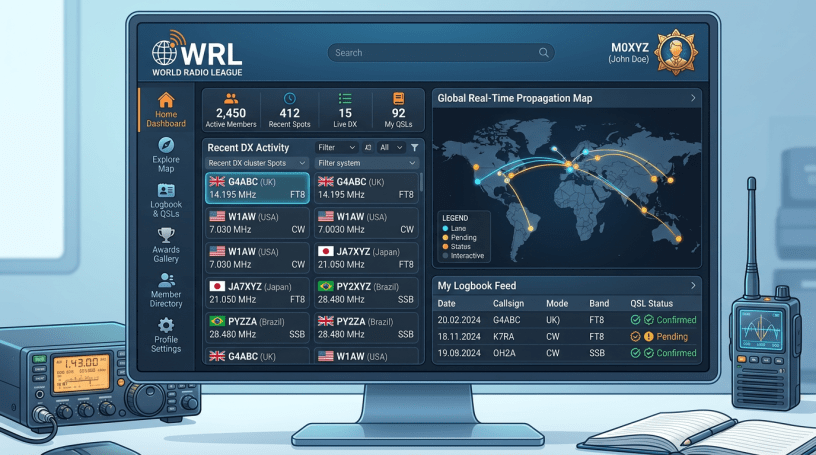
A friendly look at World Radio League and how its modern logging tools can make everyday ham radio more enjoyable.
If you’ve been active in amateur radio for a while, you’ve probably noticed that logging a QSO has changed quite a bit over the years.
What once meant writing callsigns and frequencies into a paper logbook can now involve computers, smartphones, cloud synchronization, digital modes, contest software, POTA spotting, maps, statistics, and much more.
That’s where World Radio League (WRL) comes into the picture.
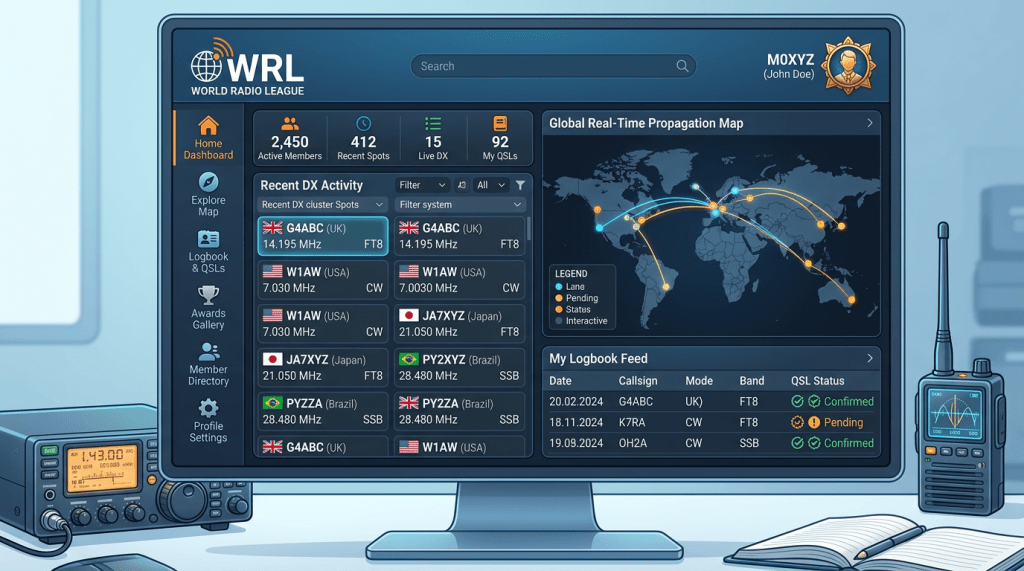
World Radio League is a modern amateur-radio platform designed to make logging and operating easier for everyone—from someone who just received their first license to experienced operators who spend weekends chasing contacts during contests and Parks on the Air activations.
The platform combines a web-based logger, mobile and desktop applications, contesting tools, POTA features, analytics, callsign lookup, ADIF support, and community features in one ecosystem. (World Radio League)
What Is World Radio League?
World Radio League describes itself as a platform for amateur radio logging, social networking, live contest scoring, education, and other operating tools.
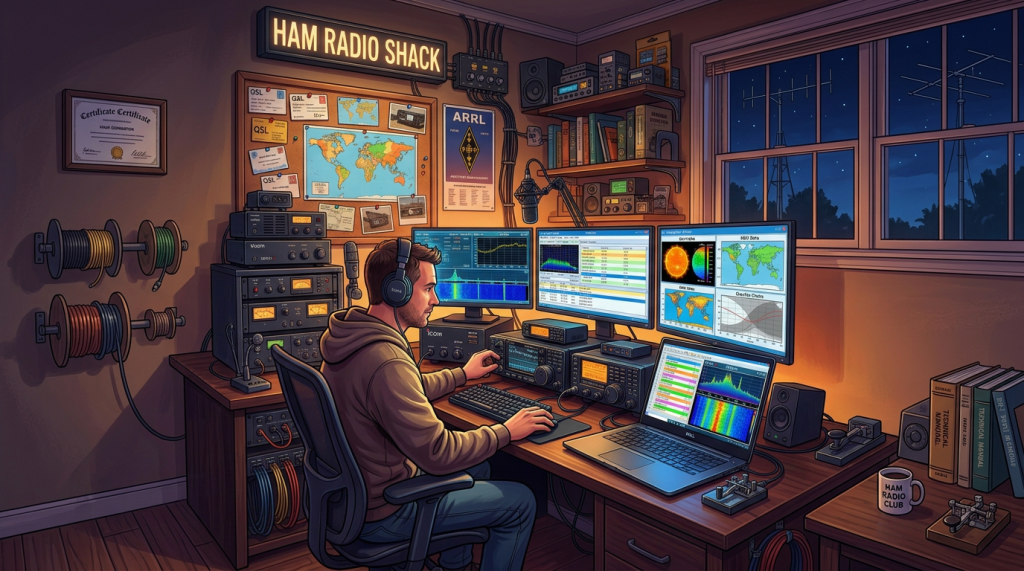
The project was launched in 2023 by James Cribbs, N0WRL, who is also the founder of Ham Radio Prep. The idea behind WRL grew from recognizing a common problem: getting an amateur radio license is only the beginning. New operators still need to figure out how to get on the air, make contacts, log those contacts, participate in activities, and become part of the amateur-radio community. (World Radio League)
That’s an important point.
Getting your license doesn’t automatically teach you how to operate a station.
Sometimes the hardest part is simply figuring out what to do after you pass the exam.
WRL is designed to help bridge that gap.
A Web-Based Logbook Without a Complicated Setup
One of the most appealing aspects of World Radio League is its web-based logging system.
You can create an account and begin building a logbook without having to install complicated software just to get started.
WRL supports different types of logbooks, including a general-purpose logger, an advanced all-fields logger, and a POTA-oriented logger. (World Radio League)
For a new operator, this can be a big advantage.
You don’t necessarily need to spend hours configuring software before logging your first QSO.
For an experienced operator, there’s another benefit: WRL isn’t limited to basic contact logging. It includes tools designed for more advanced operating activities.
Log From Your Computer, Phone, or Tablet
Modern amateur radio operators don’t always sit in front of the same computer.
You might operate from your home station one evening, take a portable radio to a park on Saturday, and then use your phone while traveling.
World Radio League is designed around that reality.
The platform supports web, mobile, and desktop applications, with contacts synchronized between devices. The mobile application also supports offline logging, allowing contacts to be recorded when you don’t have an Internet connection and synchronized later. (World Radio League)
That offline capability could be particularly useful for portable operators.
Imagine sitting at a picnic table with your HF radio, battery, antenna, and smartphone. You don’t necessarily have reliable cellular service—or perhaps you simply don’t want your operating setup dependent on an Internet connection.
You can continue logging and let the application synchronize your contacts later.
That’s a practical feature for portable operation.
POTA Operators Get Some Useful Tools
If you’re involved with Parks on the Air (POTA), WRL becomes even more interesting.
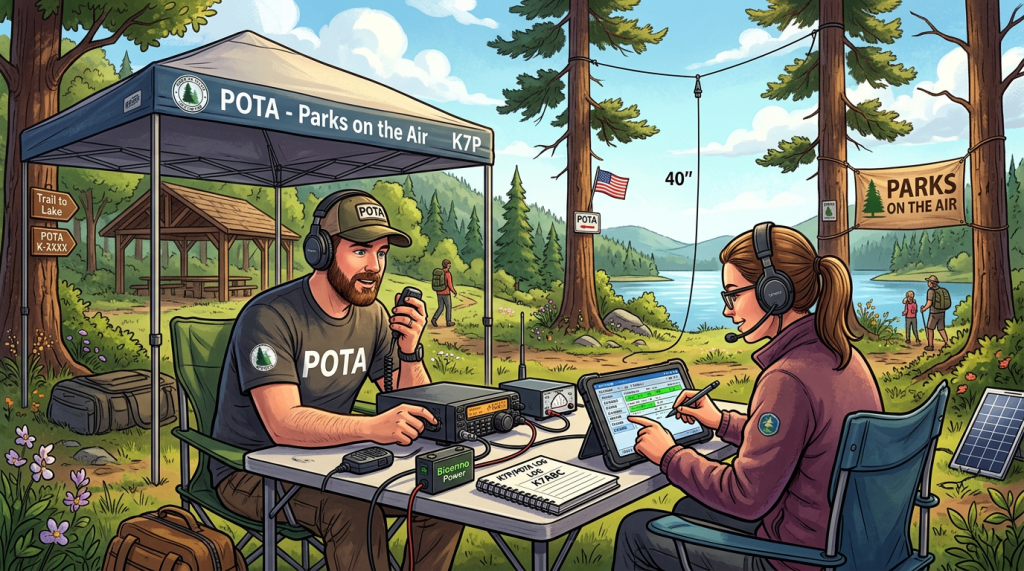
World Radio League includes POTA-oriented logging features, park references, exporting, and spotting functionality. It also supports sending spots to the POTA network directly from the logger. (World Radio League)
For a POTA activator, having logging and spotting capabilities integrated into the same workflow can make things considerably easier.
Instead of jumping between several applications and websites, you can manage much of the process from your logging environment.
And if you’ve ever tried to operate a portable station while simultaneously managing a radio, antenna, battery, logging software, and spotting, you know that anything that reduces the number of things you have to juggle is welcome.
Real-Time Contesting
Contesting is another area where World Radio League is trying to take a modern approach.
The platform supports live contest scoring, giving operators the ability to see contest activity and scoring information in real time. WRL has also expanded its contesting capabilities beyond simple logging. (World Radio League)
This is especially interesting as amateur radio contesting becomes increasingly connected.
Rather than treating the logbook as something that simply records what happened after the contest, modern contesting software can become part of the operating experience itself.
World Radio League is also serving as an official technology partner for the World Radiosport Team Championship 2026, providing live contest technology and scoreboard capabilities. (World Radio League)
That’s a significant demonstration of where the platform is headed.
ADIF Import and Export
If you’ve been in amateur radio for any length of time, you probably have a log somewhere.
Maybe it’s an older logging application.
Maybe you’ve used several different programs over the years.
Or perhaps you have a large ADIF file sitting on your computer.
Fortunately, World Radio League supports ADIF import and export. (World Radio League)
That’s important because your logbook data shouldn’t be trapped inside one particular application.
ADIF—Amateur Data Interchange Format—is widely used for transferring amateur-radio contact information between logging programs.
So if you’re considering giving WRL a try, you don’t necessarily have to start your entire logbook from scratch.
Callsign Search
Another small feature that can make logging easier is callsign lookup.
World Radio League can automatically retrieve information associated with callsigns while you’re entering contacts. (World Radio League)
For a casual operator, that’s simply convenient.
For a contest operator who’s entering contacts quickly, reducing manual data entry can save time.
And for a new ham, having additional information appear automatically can make the logging process feel much less intimidating.
Maps and Logbook Analytics
Here’s where things get a little more fun.
Your logbook isn’t just a database of callsigns.
It’s a record of your activity.
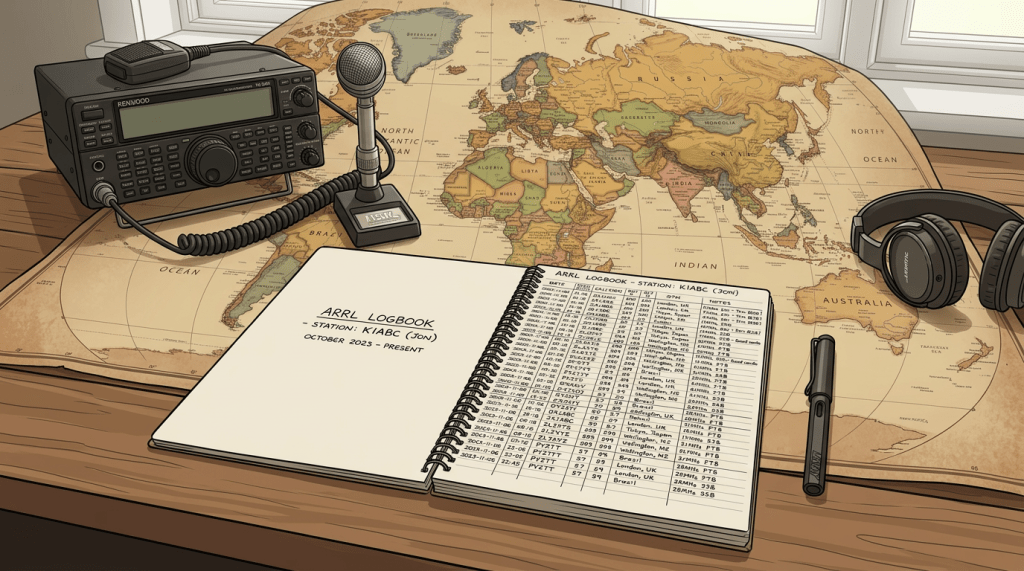
World Radio League provides logbook maps that allow operators to visualize their contacts, along with analytics such as QSO rate. (World Radio League)
For many operators, seeing that information presented visually can make the hobby even more engaging.
You might discover that you’ve worked more states than you realized.
Maybe you’ve accumulated contacts across several continents.
Or perhaps your operating activity has increased significantly over the past few months.
Sometimes seeing those numbers is just the motivation needed to turn the radio on and make a few more contacts.
Automatic QSL Cards
WRL also offers automatically generated QSL cards for contacts.
For operators who enjoy collecting and exchanging QSLs, this adds another dimension to the logging experience. (World Radio League)
Digital tools like this are interesting because they preserve some of the traditional fun of amateur radio while using modern technology to make it easier.
That’s really what WRL seems to be trying to accomplish.
It isn’t about replacing the spirit of amateur radio.
It’s about making some of the technology surrounding the hobby easier to use.
Built for New Hams—and Experienced Operators
One of the things I find most interesting about World Radio League is that it isn’t being designed exclusively for contesters.
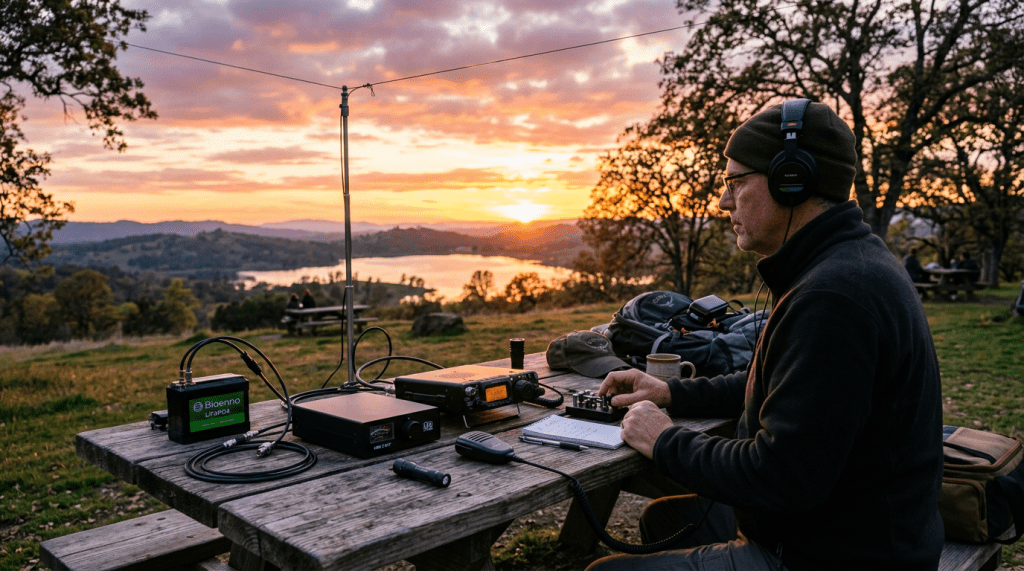
The company specifically talks about building a bridge between newly licensed operators and the more experienced amateur-radio community. (World Radio League)
That’s important.
A new Technician or General licensee can pass the exam and still have no idea what to do next.
What frequency should I use?
How do I log a contact?
What’s POTA?
What’s a contest?
How do I participate?
What software should I install?
How do I import my existing log?
Those questions can be overwhelming.
A platform that brings several of those functions together could make the learning curve considerably easier.
At the same time, experienced operators can take advantage of features such as contesting, CAT control, integrations, spotting, analytics, and advanced logging. WRL’s documentation currently includes guides for CAT control, N1MM, N3FJP, WSJT-X, QRZ, GridTracker, ADIF, POTA, and contesting. (World Radio League)
Community Is Still Important
Technology is great, but amateur radio has never been just about technology.
It’s about people.
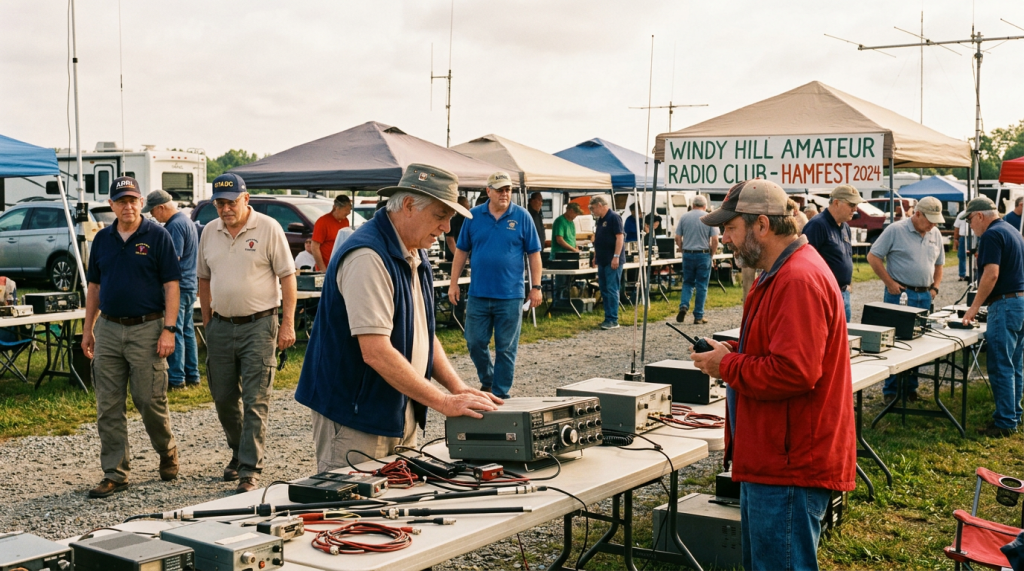
World Radio League also maintains an online community where operators can ask questions, share experiences, discuss equipment and operating techniques, and help newcomers. (World Radio League)
That’s an important part of keeping new operators involved.
Many of us can remember the first time another ham took the time to answer a question, explain a piece of equipment, help troubleshoot an antenna, or simply welcome us into a conversation.
Those interactions are what keep the hobby alive.
Getting Started With World Radio League
Getting started is relatively straightforward.
According to the WRL documentation, you can create a free account using your name and email address or use Google or Apple sign-in. You’ll then complete your profile, including your callsign, location, and other information. (World Radio League)
Once your account is established, you can configure an operating location, create a logbook, and begin entering contacts.
You can also explore the documentation and gradually add more advanced features as you become comfortable with the platform.
That last part is worth emphasizing.
You don’t have to learn everything at once.
Start with logging.
Then explore the maps.
Try POTA.
Look at the spotting features.
Experiment with integrations.
Eventually, you may find that WRL becomes a central part of your operating workflow.

Is World Radio League Worth Trying?
If you’re looking for a modern amateur-radio logging platform, World Radio League is definitely worth exploring.
The free entry point makes it easy to experiment without committing to a complicated software installation first. Its combination of web, mobile, and desktop access, cloud synchronization, ADIF support, POTA tools, contesting, spotting, analytics, and community features gives it a broad range of capabilities. (World Radio League)
For a new ham, the biggest advantage may be simplicity.
For a portable operator, offline mobile logging and POTA functionality could be the attraction.
For a contester, live scoring and contest tools may be the reason to take a closer look.
And for an operator who simply wants a modern way to maintain a logbook, the web-based interface and cross-device synchronization are compelling.
Final Thoughts
Amateur radio has always been a combination of old and new technology.
We still make contacts using radio waves, antennas, microphones, Morse code, and RF.
But today’s operator also has access to smartphones, SDRs, digital modes, cloud services, GPS, online spotting networks, and sophisticated logging software.
World Radio League fits right into that evolution.
What I like about the concept is that the emphasis isn’t simply on creating another logging program. The larger goal is to make amateur radio more accessible and more engaging while giving experienced operators increasingly powerful tools.
Whether you’re chasing POTA activations, participating in contests, building your first logbook, or simply trying to get on the air more often, WRL is an interesting platform to put on your amateur-radio toolbox.
And the best part?
You don’t have to be an expert to start using it.
Sometimes the best way to learn a new amateur-radio tool is to simply turn on the radio, make a QSO, and start logging.
73, and maybe I’ll see you in the log!
Learn More
You can explore World Radio League, create a free account, and browse its documentation here:
World Radio League Documentation
Discover more from KE2YK
Subscribe to get the latest posts sent to your email.

