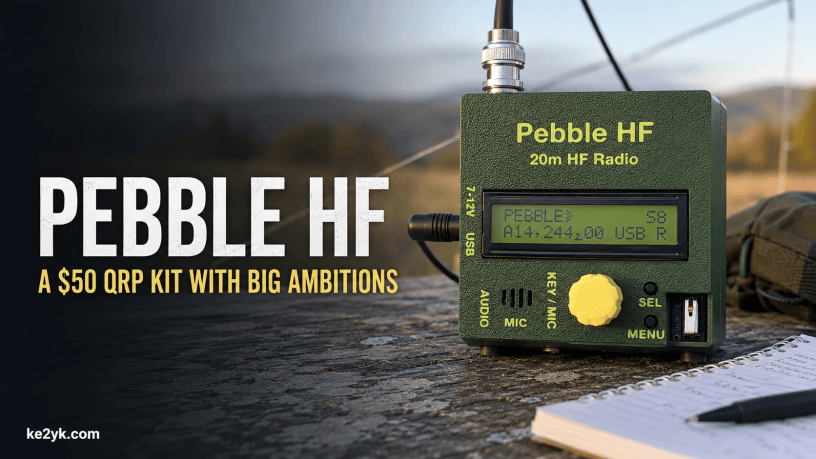
The radio is shipped programmed and tested, according to the official firmware documentation. Recent kits also include a six-pin programming header. Firmware can be updated with a browser-based utility when used with a compatible programmer and Chromium-based browser, or by using conventional programming tools.
Five watts when you have it, one watt when you don’t
Ordered My Pebble HF Sept 2026 Here’s the Link!
Pebble HF’s two power options suit portable operation. A 7-to-14-volt supply can produce up to roughly five watts. USB-C at five volts provides about one watt. The USB option doesn’t turn an ordinary power bank into a full-power supply, but it creates a low-barrier way to receive, learn the controls, and try QRPp operation using equipment many operators already carry.
One watt on 20 meters can make contacts when propagation, timing, and antennas cooperate, but it demands realistic expectations. Five watts is more forgiving, yet it is still QRP. Pebble HF won’t compensate for an inefficient antenna, poor band conditions, or high local noise. Its value is in making those experiments inexpensive and portable—not in promising effortless DX.
Useful DSP features in a deliberately modest radio
The uSDX foundation gives Pebble HF more operating flexibility than its minimalist front panel suggests. Published features include selectable DSP filters, automatic gain control, noise reduction, receive attenuation, VOX, RIT, VFO A/B, straight-key and iambic keyer modes, and a configurable CW tone.
Those features shouldn’t be mistaken for the refinement of a premium portable transceiver. This remains a cost-driven, community-supported kit. The official site explicitly says there is no warranty or guaranteed support. Buyers should expect to consult documentation, follow project updates, and participate in the community when troubleshooting.
Open source is more than a slogan here
Hardware designer Barbaros Asuroglu, WB2CBA, publishes the schematic, bill of materials, measurements, and fabrication files. Mike, N4FFF, maintains Pebble HF’s modified firmware, which builds on the uSDX work of Guido Ten Dolle, PE1NNZ. The firmware repository also contains an operating manual, troubleshooting information, programming instructions, and a public change history.
That visibility gives Pebble HF a second life as a learning platform. Builders can follow the signal path, compare measurements, inspect the code, print a community-designed enclosure, or contribute improvements. Even operators who never modify the radio benefit from documentation that can evolve alongside the hardware.
Who should consider Pebble HF?
Pebble HF makes the most sense for a new General-class operator who wants an affordable first taste of HF, a CW learner who likes the idea of a self-contained practice and operating radio, or an experienced portable operator who enjoys small open-source projects. It’s also appealing for clubs that want a group build with a manageable component count.
It is less suitable for someone who needs multiband coverage, a polished commercial support experience, high transmit power, or a radio that conceals every technical detail. Twenty meters can be productive, but a single-band transceiver inevitably leaves the operator waiting when the band is closed or conditions favor lower frequencies.
The bottom line
Pebble HF’s appeal isn’t that it replaces a QMX, IC-705, or another full-featured portable rig. It doesn’t. Its appeal is that it combines a manageable build, CW and SSB, useful DSP functions, open hardware and firmware, and genuine portable potential around an unusually low target price.
If the project can consistently deliver kits near $50, it could become a meaningful gateway to HF construction and QRP operation. Until normal retail availability and current pricing are clearly posted, prospective builders should view that number as the destination rather than a promise. The radio itself, however, has moved beyond a paper announcement: builders are assembling it, firmware is actively documented, and field operators are putting it on the air.
Follow Me on Mastodon
Official resources
- Pebble HF project site
- Pebble HF documentation hub
- Open-source Pebble HF hardware repository
- Pebble HF firmware, operating manual, and troubleshooting
- HamRadioDuo store
- Pebble HF introduction video on YouTube
Useful Accessories for the Pebble HF
The Pebble HF is intentionally simple, but a few well-chosen accessories can make it easier to power, tune, and operate in the field. These five products are especially relevant to a compact 20-meter QRP station.
- GABIL GRA-7350TC portable HF antenna: A compact telescoping antenna that covers 20 meters. It requires a compatible 3/8-24 mount, a counterpoise, and careful adjustment before transmitting.
- Anker 737 Power Bank: A 24,000 mAh USB-C power source for lightweight portable operation. Pebble HF can produce approximately one watt from five-volt USB-C power.
- AURSINC NanoVNA-H4 antenna analyzer: Useful for checking and adjusting antenna SWR before connecting the radio—particularly when using portable whips and field-built antennas.
- Panasonic ErgoFit RP-HJE120 wired earbuds: An inexpensive and lightweight 3.5 mm listening option that packs easily in a portable radio bag.
- Sabrent AU-MMSA USB audio adapter: A possible starting point for digital modes. Additional audio cables, signal-level adjustment, and appropriate isolation may still be required.
As an Amazon Associate, I earn from qualifying purchases. Product prices and availability may change. Always confirm connector requirements, voltage, polarity, antenna tuning, and accessory compatibility before use.
Discover more from KE2YK
Subscribe to get the latest posts sent to your email.

