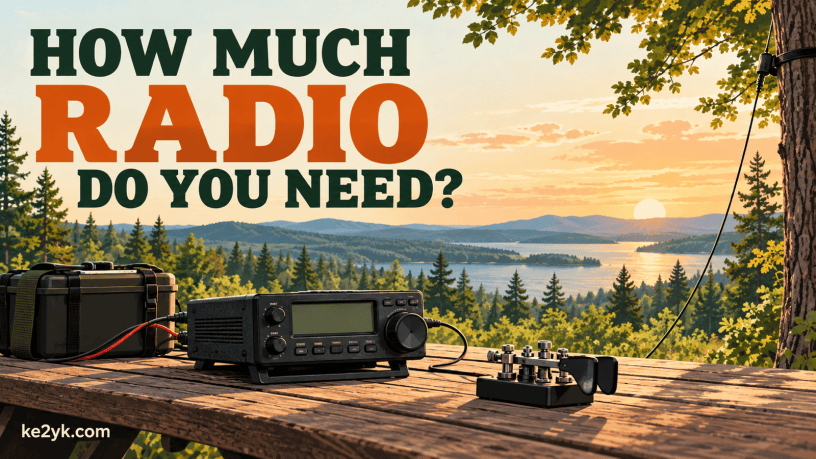
Two small QRP radios offer a useful starting point for thinking about what belongs in a portable station—and what earns its weight in the pack.
POTA rig selection starts with the features you actually use during an activation. Once the antenna is up and the headphones are on, the priorities become straightforward: hear stations, make contacts, and keep the station running.
In his October 3, 2026, field report, Steven Krumm, KV4AN, describes a POTA activation intended to test new portable equipment. At Tennessee’s Tims Ford State Park, Steven took two previously untested-in-the-field radios: a CFT1 for CW and a QRP Labs QMX primarily for FT8.
The CFT1 covers five bands from 40 through 15 meters and operates CW only. Steven describes a deliberately simple interface centered on tuning, volume, battery-voltage indication, and stored messages. His first stretch on 20-meter CW produced 13 contacts in less than half an hour. Switching to the QMX added seven FT8 contacts in about 20 minutes.
Those results aren’t a controlled comparison between radios or modes. They do provide a useful springboard for a broader question: how much capability does your particular activation need?
Start with the activation
For a short CW outing, a compact radio with familiar controls can be an appealing choice. Every function you regularly use should be easy to reach, especially when the picnic table is damp, the wind picks up, or you have only an hour to operate.
A more versatile portable radio earns its place when you expect to change modes, explore different operating approaches, or use the same equipment for several kinds of outings. Extra capability is valuable when it supports something you actually intend to do.
The useful distinction is between features you depend on and features you simply carry.
For another perspective on portable-radio capability, see my R1CBU X6100 firmware overview. It explores the software side of a more configurable portable station.
Weigh the whole station
The transceiver is only part of the load. Count the battery, antenna, feed line, supports, key or microphone, headphones, and any equipment needed for logging or digital operation.
Digital modes can add a phone or computer, connecting cables, and another power budget. A small radio doesn’t automatically make the complete station small.
Battery planning deserves the same attention. Compare documented receive and transmit current at the settings you expect to use, along with the radio’s permitted supply voltage. Low RF output alone doesn’t tell you how long a battery will last.
My Portable Power Wiring: How to Stop Voltage Drop guide covers the cables, connections, and under-load checks that help keep a field station running.
The antenna deserves equal attention. See Portable QRP Antenna Troubleshooting: Beyond 1:1 SWR for practical checks of deployment, feed-line losses, and the return path.
Practice matters as much as menus
Simple controls can reduce the number of things you need to remember. A capable radio with deeper menus can also become comfortable field equipment if you prepare it beforehand.
Before packing, try the complete station at home. Confirm the operating settings, cables, software, and power arrangements. Then practice moving between the bands and modes you plan to use.
The park is a useful place to test an operating plan. It’s a frustrating place to discover that one essential cable is still on the bench.
What earns a place in your pack?
The right POTA radio depends on the outing. A CW-focused operator and someone planning a mix of CW and digital contacts may reasonably pack different stations.
Steven’s report is worth reading as an account of testing equipment under actual operating conditions. For the rest of us, it offers a practical prompt: build the station around the contacts you want to make, then decide which additional capabilities justify their weight, power needs, and setup time.
When you head out for POTA, which radio feature do you rely on most—and which could you happily leave behind?
Gear from Steven’s field station
Steven’s equipment list provides a starting point for planning a similar outing:
- CFT1 and QMX: the two transceivers used for his field tests.
- Chameleon Basic Vertical: his portable antenna.
- CW Morse Outdoor Paddle: his CW input device.
- TRIWONDER small MOLLE belt pouch: used as a cover for his custom battery pack.
- RigExpert AA-30 and HP Stream laptop: his antenna analyzer and computer; the report identifies these models as no longer available.
Related gear on Amazon
As an Amazon Associate I earn from qualifying purchases.
TRIWONDER small MOLLE belt pouch: the Amazon-listed accessory in Steven’s equipment list. Check the selected size and your battery’s dimensions before ordering; a pouch does not replace insulated terminal protection.
Find the TRIWONDER small MOLLE belt pouch on Amazon (affiliate link). This link opens Amazon search results; check the listing for the correct version.
Follow Me on Mastodon
Discover more from KE2YK
Subscribe to get the latest posts sent to your email.

