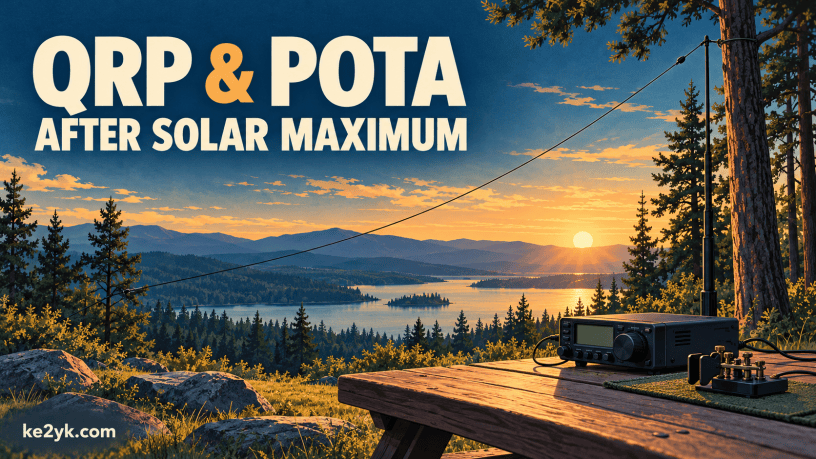
Quieter solar conditions call for a more flexible portable station. Keep 20 meters, make room for 30 and 40, and give your antenna as much attention as your radio.
If your recent park activations have leaned heavily on the higher HF bands, a changing solar cycle is a good reason to revisit your field kit. QRP and POTA after solar maximum remain practical, but the band that produced easy contacts last season may require better timing—or a change of frequency—next time out.
The ARRL Solar Report for October 2, 2026 described declining sunspot-cycle activity and limited long-distance opportunities on 10 and 12 meters. It also highlighted useful 20-meter conditions and nighttime DX opportunities on 30, 40 and 80 meters. That was a forecast for a particular period, not a permanent verdict on any band.
What changes as solar activity decreases?
Solar radiation helps create the ionosphere that bends HF signals back toward Earth. As activity decreases, the highest usable frequency on a particular path generally falls. Higher-band openings can become shorter or less frequent, while lower frequencies remain usable. Time of day, season and location still matter, as the Australian Bureau of Meteorology’s HF propagation guide explains.
A declining cycle also differs from a sudden disturbance. Solar flares can increase absorption on sunlit paths, and other space-weather events can disrupt HF communications. NOAA’s HF radio overview explains those short-term effects. One difficult afternoon does not tell you how the next several years will sound.
Give 20, 30 and 40 meters different jobs
20 meters: keep it in the rotation. It remains a sensible starting point for reaching more distant hunters during daylight. Check actual activity before committing an entire activation to it, and be ready to move when replies slow down.
30 meters: add another option for CW. For a portable CW operator, this is a useful band to test between 20 and 40 meters. Include it in your antenna plan and compare results at different hours rather than assuming it will always outperform either neighbor.
40 meters: broaden your reach to regional hunters. It can offer shorter-distance opportunities that a higher band misses. After dark, reduced lower-ionosphere absorption can also support longer paths. The tradeoffs include more antenna length and potentially more noise.
These are starting points, not guaranteed coverage zones. Antenna height and radiation pattern help determine which hunters hear you. Eighty meters deserves consideration for evening outings when space permits, but it need not be the first addition to a compact daytime kit.
Choosing Bands for QRP and POTA
| Band | Role in your field plan | What to watch |
|---|---|---|
| 20 m · Keep | Start here for daytime contacts with more distant hunters. | Check activity; openings depend on the path and hour. |
| 30 m · Add | Give your CW activation another option between 20 and 40 m. | Compare results at different times; do not assume automatic improvement. |
| 40 m · Expand | Try regional hunters by day and longer paths after dark. | Allow for more antenna length, noise and daytime absorption. |
| 80 m · Optional | Consider evening operation when the site permits. | Larger antenna footprint; darkness does not guarantee a quiet band. |
Make the antenna upgrade before the next outing
Start by asking whether your current antenna gives you a practical way to use 40 meters. A linked dipole or another properly configured multiband wire can make band changes straightforward. ARRL’s HF antenna resources offer a starting point for comparing simple designs.
A compact loaded antenna may be the right choice for a small site or a quick stop. Where space allows, compare it with a longer wire using similar operating conditions. A low SWR alone does not establish how efficiently the station radiates: matching, antenna losses and the installation all deserve attention.
Portable Dipole Lengths by Band
Before packing a dipole, check the space available. These approximate starting lengths use the common formula total length in feet = 468 ÷ frequency in MHz. Each leg is half the total. Cut slightly long and trim for the actual installation.
| Example frequency | Total wire length · common scale | Each leg |
|---|---|---|
| 20 m 14.06 MHz | 33.3 ft / 10.1 m | 16.6 ft |
| 30 m 10.12 MHz | 46.2 ft / 14.1 m | 23.1 ft |
| 40 m 7.03 MHz | 66.6 ft / 20.3 m | 33.3 ft |
| 80 m 3.56 MHz | 131.5 ft / 40.1 m | 65.7 ft |
Try a more flexible activation routine
- Check conditions, then listen. Use space-weather reports as context and activity on the receiver as evidence.
- Arrive with a second-band plan. Know how you will switch the antenna before leaving home.
- Make yourself findable. Keep your activation spot accurate when you change frequency or mode.
- Change one thing at a time. Try another band or a different operating hour, then note the result.
- Keep a short field record. Record band, time, antenna configuration and where your contacts were located. Patterns across several outings are more useful than one slow session.
QRP Antennas and Field Gear on Amazon
Affiliate disclosure: As an Amazon Associate I earn from qualifying purchases.
Browse these gear categories and compare compatibility and included accessories in each listing.
- Portable multiband wire antenna — Look for explicit 20-, 30- and 40-meter coverage; check tuner and feed-line requirements.
- Compact HF vertical — A space-saving option for small sites. Check band coverage and required radials or counterpoise.
- Fiberglass support mast — Supports a lightweight wire where trees are unavailable. Compare packed length, height and load capacity.
- 50-ohm coax and adapters — Choose a practical cable length and connectors that match your radio and antenna.
- LiFePO4 field battery — Match fully charged voltage, current capacity and polarity to your radio; use a suitable charger and fused lead.
- Portable HF antenna analyzer — Helps check resonance and SWR in the field. Confirm HF coverage; low SWR alone does not prove antenna efficiency.
Keep taking the radio outdoors
The practical preparation is modest: retain your higher-band capability, add workable lower-band coverage, and leave room to adapt. A portable station that can move comfortably among 20, 30 and 40 meters gives you more ways to find contacts as conditions change. The next improvement may be an extra length of wire and a different operating hour.
Follow Me on Mastodon
Discover more from KE2YK
Subscribe to get the latest posts sent to your email.

