Modernized Connectivity Meets Superior RF Performance in Icom’s Next-Generation SDR
The ICOM IC-7300 changed the HF radio market when it brought RF direct-sampling SDR technology, a real-time spectrum scope, waterfall display, and 4.3-inch touchscreen into an affordable 100-watt transceiver. Even years after its introduction, the IC-7300 remains an extremely capable HF/50 MHz radio and provides most of what the average amateur radio operator needs for SSB, CW, FT8, RTTY, and general HF operation.
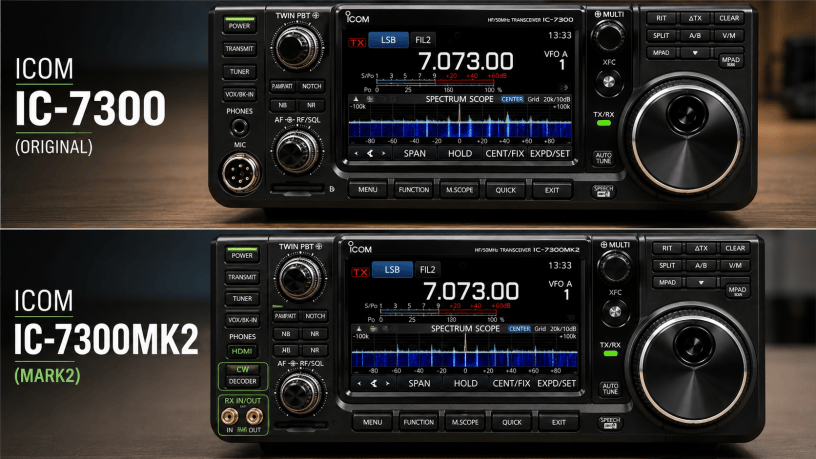
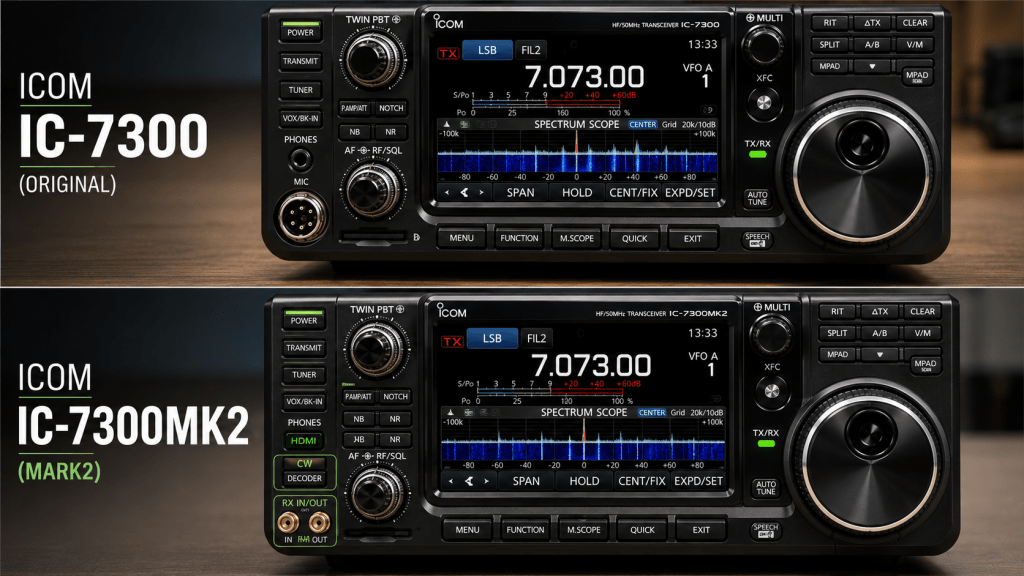
The IC-7300MK2 doesn’t abandon that successful formula. Instead, Icom has taken the original 7300 and improved several areas that experienced operators are likely to appreciate. The MK2 retains the familiar 100-watt output, 4.3-inch touchscreen, RF direct-sampling receiver, spectrum scope, waterfall display, automatic antenna tuner, and compact desktop design while adding better receiver performance, cleaner transmit characteristics, improved connectivity, and several new operating features. (Icom America.)
One of the most important improvements is receiver performance in the presence of strong nearby signals. Icom states that the MK2 improves Reciprocal Mixing Dynamic Range (RMDR) by more than 12 dB compared with the original model. Transmit phase-noise performance is also improved by more than 12 dB. These aren’t necessarily upgrades that jump out at you during a casual afternoon QSO, but they can become much more important when operating during contests, DX pileups, Field Day, or other crowded-band situations. (ICOM America.)
The MK2 also modernizes the radio’s connectivity. You now get an HDMI output for displaying the radio’s frequency, spectrum scope, waterfall, and menus on a larger monitor. There’s also USB Type-C with dual virtual COM ports and audio, allowing applications such as FT8 software and logging or contest software to operate simultaneously through a single USB connection. A built-in LAN port simplifies remote operation using Icom’s RS-BA1 software, while dedicated RX antenna IN/OUT connectors provide considerably more flexibility for receiving antennas, external filters, and preamplifiers. (ICOM America.)
CW operators receive some particularly useful upgrades. The IC-7300MK2 includes a built-in CW decoder, eliminating the need for a computer simply to decode Morse signals, along with an Audio Peak Filter (APF) designed to improve CW intelligibility. (ICOM America.)
Efficiency has improved as well. The original IC-7300 draws approximately 0.9 A during receive standby, while the MK2 reduces that figure to approximately 0.7 A. Icom has also redesigned the radio to produce less heat and refined the cooling-fan control, potentially making the MK2 better suited to long operating sessions. (ICOM America.)
IC-7300 vs. IC-7300MK2 Side-by-Side
| Feature | Icom IC-7300 | Icom IC-7300MK2 |
| Radio Type | HF/50 MHz SDR transceiver | HF/50 MHz SDR transceiver* |
| RF Architecture | Direct-sampling SDR | Direct-sampling SDR |
| Maximum Output | 100 W | 100 W |
| Display | 4.3-inch color touchscreen | 4.3-inch color IPS touchscreen |
| Spectrum Scope | Yes | Yes |
| Waterfall Display | Yes | Yes |
| Automatic Antenna Tuner | Yes | Yes |
| RMDR | About 100 dB typical at 2 kHz separation | Improved by more than 12 dB |
| TX Phase Noise | Original design | Improved by more than 12 dB |
| RX Standby Current | Approx. 0.9 A | Approx. 0.7 A |
| HDMI External Display | No | Yes |
| Built-in CW Decoder | No | Yes |
| CW Audio Peak Filter (APF) | No | Yes |
| USB Connection | USB | USB Type-C |
| Dual Virtual COM Ports | No | Yes |
| Built-in LAN/Ethernet | No | Yes |
| Direct Network Remote Operation | More limited / computer-based setup | Yes, with RS-BA1 |
| Dedicated RX Antenna IN/OUT | No | Yes — SMA IN/OUT |
| One-Touch FT8 Preset | Yes | Yes |
| SD Card Slot | Yes | Yes |
| Memory Channels | 101 | 101 |
| Cooling/Heat Management | Standard | Improved |
| Approx. Weight | 9.3 lb / 4.2 kg | 9.0 lb / 4.1 kg |
| U.S. HF/50 MHz Coverage | Yes | Yes |
| 70 MHz Operation | No | Europe version only* |
*The 70 MHz capability applies to the European version of the IC-7300MK2 and should not be considered a feature of the standard U.S. model.
So, Is the IC-7300MK2 Really Worth the Upgrade?
That’s where the comparison becomes interesting.
If you already own an IC-7300 and primarily operate casual SSB, FT8, or occasional CW, the original radio hasn’t suddenly become obsolete. It still offers an excellent spectrum scope, waterfall, touchscreen interface, 100-watt transmitter, automatic tuner, and direct-sampling SDR receiver. For many operators, those capabilities are more than enough.
The argument for upgrading becomes considerably stronger if you’re a serious contester, DXer, CW operator, digital-mode enthusiast, or remote operator. Better RMDR and transmit phase noise can matter on crowded bands. HDMI output is attractive for operators who want a large spectrum and waterfall display. USB-C with dual COM ports simplifies computer integration, while Ethernet and dedicated receive-antenna connections make the MK2 a substantially more flexible station radio.
The built-in CW decoder and APF are also meaningful additions for Morse operators, while lower standby consumption and reduced heat generation are welcome improvements for long-duration operation.
The Bottom Line
The IC-7300MK2 is clearly the better radio, but that doesn’t automatically make it a necessary upgrade for every IC-7300 owner.
If you’re buying your first IC-7300-series radio, the MK2 is the obvious model to consider if your budget allows. You’re getting the familiar operating experience that made the original so successful along with better RF performance and significantly more modern connectivity.
But if there’s already an IC-7300 sitting on your desk, the decision isn’t quite as simple. The real question isn’t whether the MK2 is better—it is.
The question is whether HDMI, Ethernet, USB-C, dedicated RX antenna connections, improved RMDR, cleaner transmit performance, lower power consumption, and the new CW features are worth paying for when your original IC-7300 may already do everything you need.
And for quite a few IC-7300 owners, the answer may still be no.
The biggest improvements are therefore not higher power or a dramatically different user interface—they’re better RF performance, connectivity, CW capability, and station integration. That’s a useful angle for your article because it makes the “Is the upgrade really worth it?” question much more debatable.
For reference, here are ICOM’s official product pages: ICOM IC-7300 specifications and ICOM IC-7300MK2 specifications.
73 KE2YK
Discover more from KE2YK
Subscribe to get the latest posts sent to your email.

